A Maintenance management system is a combination of people, software, and systems, all working towards keeping assets and equipment efficient and reliable.
A Maintenance Management System can be classified into several types based on how maintenance activities are planned, triggered, and managed.
Types of Maintenance Management system
-
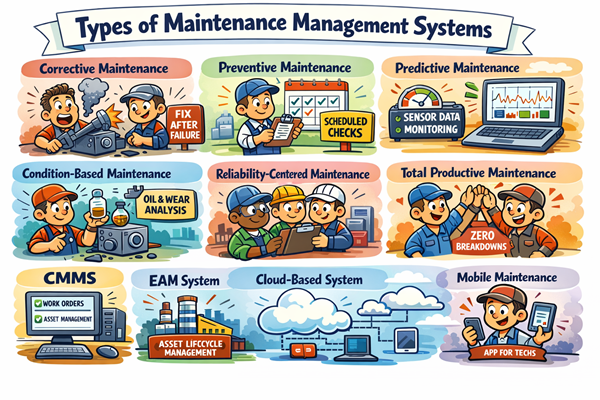
Reactive Maintenance (Breakdown Maintenance)
- Maintenance is performed after equipment fails
- No planning or scheduling in advance
Best for:
Small businesses, non-critical assets
Pros:
- Low upfront cost
- Simple to manage
Cons:
- High downtime
- Costly emergency repairs
-
Preventive Maintenance Management
- Maintenance tasks are scheduled at regular intervals
- Based on time, usage, or calendar dates
Examples:
- Monthly equipment inspections
- Oil changes after fixed running hours
Pros:
- Reduces unexpected failures
- Extends asset life
Cons:
- May lead to over-maintenance
-
Predictive Maintenance Management
- Uses real-time data and condition monitoring
- Predicts failures before they occur
Technologies used:
- IoT sensors
- Vibration analysis
- Temperature monitoring
Pros:
- Minimal downtime
- Highly cost-effective long-term
Cons:
- Higher setup cost
- Requires technical expertise
-
Condition-Based Maintenance (CBM)
- Maintenance is triggered when asset condition crosses a threshold
- Similar to predictive but simpler
Pros:
- Maintenance only when needed
- Less waste than preventive maintenance
Cons:
- Requires monitoring tools
-
Corrective Maintenance Management
- Repairs are made after detecting a fault, but before failure
- More planned than reactive maintenance
Pros:
- Avoids total equipment breakdown
- Better cost control
Cons:
- Still some risk of downtime
-
Reliability-Centered Maintenance (RCM)
- Focuses on critical assets
- Maintenance strategy is based on asset importance and risk
Used in:
- Manufacturing
- Aviation
- Power plants
Pros:
- Highly optimized maintenance strategy
- Improves safety and reliability
Cons:
- Complex to implement
-
Computerized Maintenance Management System (CMMS)
- Software-based system to manage maintenance operations
Key features:
- Work order management
- Asset tracking
- Inventory management
- Maintenance scheduling
Best for:
Businesses scaling their maintenance operations
-
Enterprise Asset Management System (EAM)
- Broader than CMMS
- Manages the entire asset lifecycle
Includes:
- Procurement
- Maintenance
- Compliance
- Disposal
Best for:
Large enterprises and multi-site operations